
-
SeAH Newsroom 3
Realizing a sustainable future for companies and humanity through resource circulation
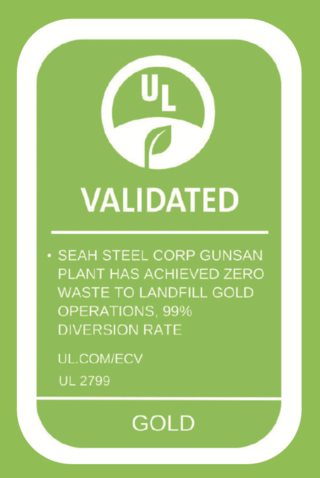
SeAH Steel Gunsan Plant acquires Zero Waste to Landfill certification
Realizing a sustainable future for companies and humanity through resource circulation
SeAH Steel Gunsan Plant acquires Zero Waste to Landfill certification
SeAH Steel actively practices environment friendly management, socially responsible management, and compliance management to advance a sustainable future. In particular, SeAH Steel’s Gunsan Plant has actively promoted waste reduction activities under the SHE (Safety, Health, Environment) system, resulting in obtaining the Zero Waste to Landfill (ZWTL) Gold certification from UL (Underwriters Laboratories), a global safety and environmental certification agency.
SeAH Steel’s efforts to strengthen waste management at the Gunsan Plant led to the acquisition of an international environmental certification. This is the acquisition of the Zero Waste to Landfill (ZWTL) certification, a global indicator that evaluates companies’ resource circulation practices.
The ZWTL certification is a qualification-based certification awarded to companies that meet the standard of 80% or higher, evaluating the resource circulation rate of waste inevitably generated at the site. The certification is divided into three levels based on the rate of waste recycling without incineration or landfill: Platinum (99.5-100%), Gold (95-99.5%), and Silver (90-95%).
The certification process involves several steps: ▲ preliminary review (analysis of facility boundaries and waste treatment status) ▲ certification progress (on-site inspection, waste treatment process inspection) ▲ grade calculation (calculation of resource circulation rate, grade classification) ▲ renewal (annual renewal inspection).
SeAH Steel’s Gunsan Plant introduced by-product recycling facilities in 2022 and 2023 to maximize waste reduction effects. Through this, zinc included in by-products was regenerated and reused, achieving not only cost savings on raw materials but also reducing the amount of dust waste generated, thereby establishing an environmentally friendly production system.
The annual zinc reuse amount at SeAH Steel’s Gunsan Plant is approximately 131 tons, resulting in a cost saving of 340 million won per year on zinc purchases. Additionally, the amount of dust waste generated was 1,079.34 tons in 2022 and 1,076.41 tons in 2023. Compared to 2021, before the introduction of the by-product recycling facilities, the reduction was 11.9% in 2022, and the cumulative reduction rate reached 12.15% by 2023.
In 2024, the existing dewatering equipment was replaced with a membrane filter press to reduce the amount of sludge generated during wastewater treatment. The sludge from wastewater treatment refers to the dewatered state of sludge produced during the treatment of contaminated wastewater with chemicals. After replacing the dewatering equipment with a membrane filter press, the moisture content of the sludge improved to 60%, a 15% decrease from before. Consequently, the amount of waste treated decreased from 1,341.64 tons in 2023 to 974.14 tons in 2024. The treatment cost was also reduced from 225.8 million won in 2023 to 137.49 million won in 2024.
The acquisition of the Zero Waste to Landfill (ZWTL) certification by SeAH Steel’s Gunsan Plant is expected to have positive effects such as enhancing environmental business competitiveness, building an image as a leading resource circulation company, and increasing corporate credibility through ESG management practices. Additionally, it provides a foundation for proactively responding to customer needs that require third-party certified products. Most importantly, the most significant meaning of this certification is that it contributes to international sustainable development by maximizing waste recycling and reducing greenhouse gas emissions.
SeAH Steel plans to continue promoting increased resource circulation rates at all its facilities in the future, pursuing sustainable growth while strengthening business competitiveness and actively practicing corporate social responsibility.

-
04036SeAH Tower, 45, Yanghwa-ro, Mapo-gu, Seoul,
Republic of Korea